
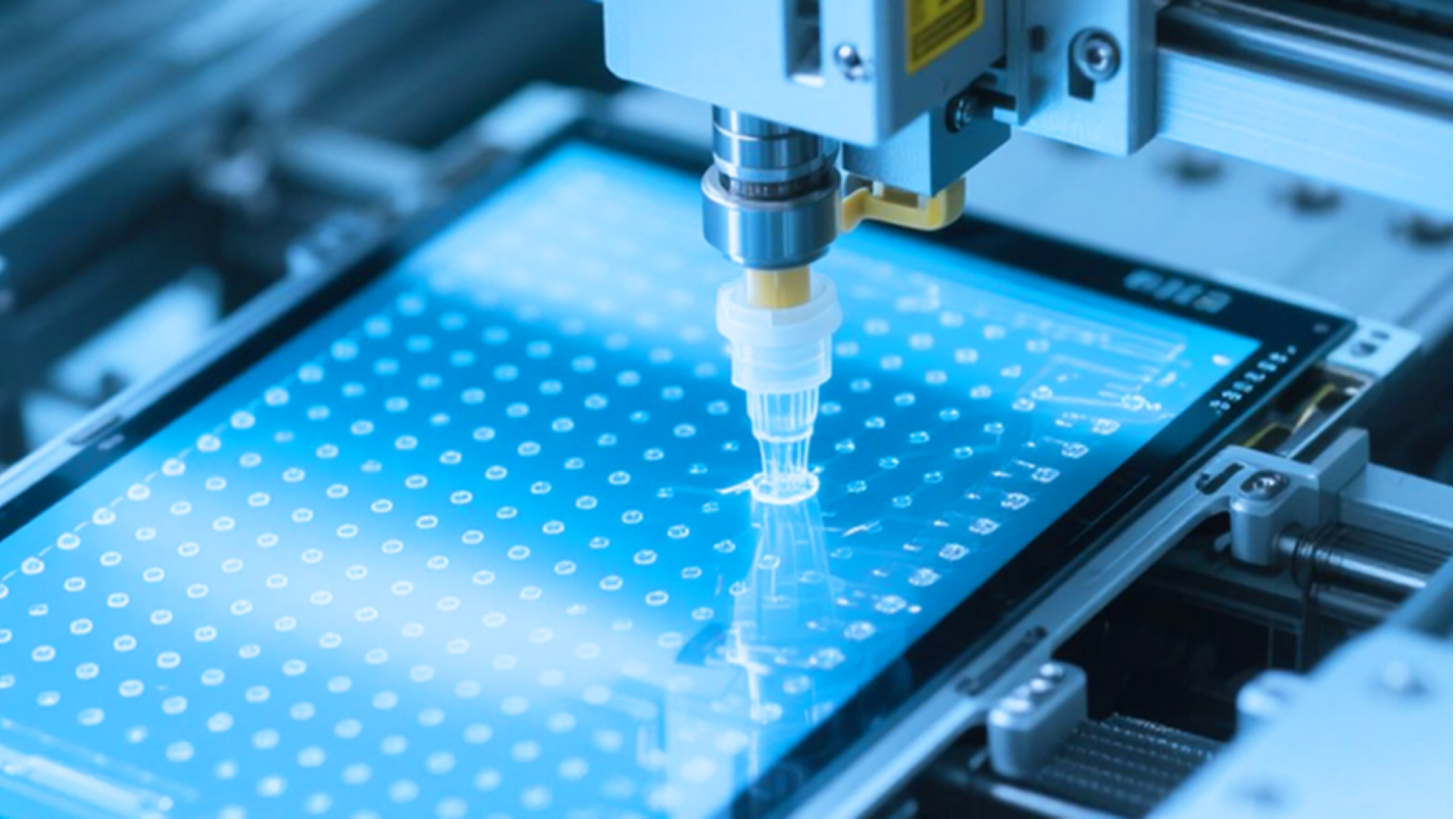
Core IPC for G8.6+ OLED production equipment
In the display semiconductor industry, particularly for high-generation OLED production lines such as G8,G8.6, targeting IT devices, foldable displays and large-size applications, precision processes including vacuum coating and magnetron sputtering impose extremely stringent requirements on equipment stability and real-time control. As the core computing unit of production equipment, HWAINTEK' s HRC series 4U industrial PCs undertake critical tasks such as process parameter monitoring, motion control, data acquisition and real-time decision-making, ensuring high yield and high efficiency of large-size Mother Glass substrates throughout complex manufacturing processes.
EAC Section Equipment: Core for Large-Substrate Handling and Front-End Processes
The EAC (Large Substrate Handling) section is primarily responsible for processing array-completed large-size substrates via cutting, protective film lamination, laser processing and other operations to fabricate individual display Cells. As a pivotal front-end stage in flexible OLED panel manufacturing, it directly impacts downstream product yield.
Typical process steps include:
Laser Cutting & Stripping: Precision laser cutting, stripping and curing of the support film in the bendable zones of flexible panels to avoid damage and deformation of the PI layer in subsequent processes.
Large-Substrate Lamination & Protection: Lamination of support films or protective layers to enable precise separation of individual panels from the mother glass.
Inspection & Conveyance: Integrated optical inspection, automatic loading/unloading and waste removal to guarantee cutting accuracy and surface cleanliness.
Within this equipment lineup, 4U rack-mount industrial PCs serve as the central computing hub. Equipped with high-performance CPUs, multi-channel I/O interfaces and industrial-grade reliability, they drive laser systems, precision motion axes and vacuum environment control in real time. The industrial PCs process massive volumes of sensor data (position, temperature, power, vision feedback) and coordinate with PLCs or motion controllers to deliver sub-micron precision control and dynamic adjustment of process parameters. For high-throughput production of G8.6 and above large-size substrates, their shock resistance, dust resistance and long-term failure-free operation capabilities are indispensable.
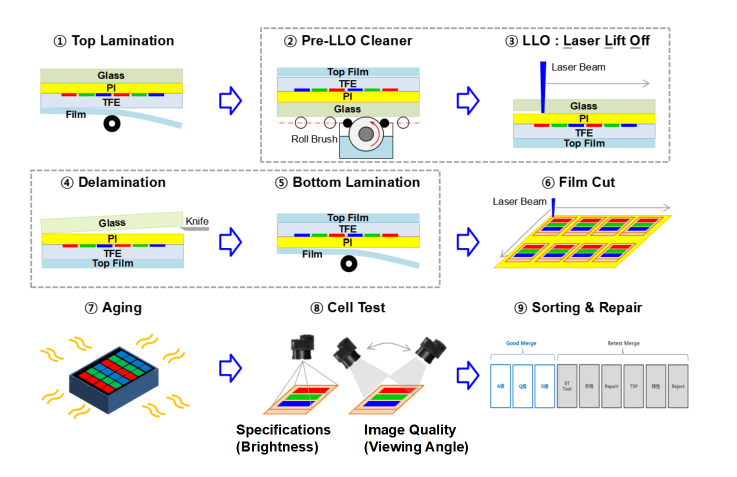
TOP LAMI/BOTTOM LAMI
Module Section Equipment: Back-End Assembly and Finished Module Manufacturing
The Module section covers back-end processes that assemble cut OLED Cells into complete display modules, encompassing circuit bonding, lamination, inspection and aging, ultimately outputting finished display modules ready for end-product integration.
Key process steps include:
Bonding: COG (Chip on Glass) and FPC bonding, which achieve high-precision electrical connections between ICs/FPCs and panel electrodes via Anisotropic Conductive Film (ACF).
Assembly & Lamination: Automatic or semi-automatic assembly of components including backlights, touch sensors and polarizers.
Inspection & Aging: Optical inspection (brightness, chromaticity, defects), Gamma calibration and environmental aging tests to validate the reliability of finished modules. Battery testing equipment is also commonly integrated in this stage to verify electrical performance at the module level.
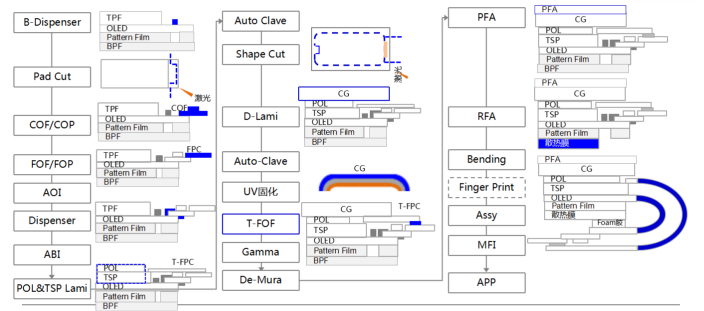
MDL – Process Flow
HWAINTEK industrial PCs function as the "neural center" in this section, tasked with multi-axis motion synchronous control, execution of visual positioning algorithms, real-time quality judgment and full traceability of production data. They support multi-display output, abundant expansion interfaces (PCIe, USB, serial ports, etc.) and built-in edge computing power to rapidly run AI-aided defect detection algorithms, sustaining high-speed takt times for high-generation production lines.